

Why Youth Athletes Need Age-Appropriate Strength Training
Youth strength training has shifted from a controversial topic to a core pillar of long-term athletic development. Across sports academies, school programs, and community clubs, well-designed resistance training is now seen as essential for building robust, resilient young athletes rather than something to be delayed until "they're older." Yet misconceptions persist: that lifting will stunt growth, damage joints, or is only for teenagers chasing bigger numbers in the gym.
For parents, coaches, and young athletes themselves, the real question is not whether strength training is safe or useful, but how to do it in an age-appropriate way. When programs are tailored to developmental stage, supervised by qualified adults, and built around movement quality rather than heavy loads, strength training can support performance, health, and long-term participation in sport. This awesome read looks at what the evidence actually says, why age-appropriate strength work matters, how programs should differ for children and adolescents, and what practical safeguards help keep youth athletes safe and progressing.
What the science says about youth strength training
Over the past two decades, a strong body of research has overturned many older fears about resistance training in children. Position stands from the American Academy of Pediatrics (AAP), the National Strength and Conditioning Association (NSCA), and the UK Strength and Conditioning Association all support supervised youth strength training as safe and beneficial when properly designed.
The AAP notes that resistance training can improve strength, body composition, motor skills, and sports performance, and may reduce sports injuries when it emphasizes technique and uses appropriate loads. The NSCA's long-standing position is that preadolescents and adolescents can increase strength through properly supervised training, with injury rates significantly lower than in many common youth sports such as soccer or basketball. Similar conclusions are echoed by organizations such as the International Olympic Committee (IOC) and World Health Organization (WHO), which both highlight the importance of muscle-strengthening activities as part of children's physical activity guidelines.
Meta-analyses have shown that children as young as 7-8 can make meaningful strength gains, largely through neural adaptations-better coordination, improved motor unit recruitment, and more efficient movement patterns-rather than big increases in muscle size. Adolescents, with rising levels of hormones like testosterone and growth hormone, can then add more muscle mass and power on top of those neural foundations.
Crucially, large reviews of injury data show that most strength-training injuries in youth occur when programs are unsupervised, loads are excessive, or technique is poor. When training is supervised by knowledgeable adults, uses sensible progression, and prioritizes proper form, resistance training is no more dangerous-and often less dangerous-than many competitive sports themselves.
Debunking common myths: growth plates, stunting, and "too young to lift"
One of the most persistent fears is that lifting weights will damage growth plates and stunt height. Growth plates (epiphyseal plates) are areas of developing cartilage at the ends of long bones and are indeed vulnerable to high-impact trauma, such as falls or uncontrolled collisions. However, there is no convincing evidence that properly supervised strength training harms growth plates or limits adult height.
Most documented growth plate injuries in children come from accidents such as falls from height, improper use of equipment, or contact injuries in sport, not from structured resistance training using controlled movements. When loads are appropriate, movements are taught and monitored, and sessions avoid maximal, uncontrolled efforts, compressive and tensile forces remain within safe ranges for developing bone. In fact, mechanical loading through resistance exercise can help improve bone mineral density, which is particularly important during the years of rapid growth.
Another myth is that children are "too young" to benefit until puberty. While young children will not gain large visible muscle mass, they do develop better neuromuscular control, balance, and coordination, all of which translate into greater agility and control in sport. Programs for younger athletes simply look very different from those for older teens: more bodyweight movement, play-based drills, and low-load, high-quality repetitions.
This is why organizations like the American College of Sports Medicine (ACSM) and CDC emphasize that muscle-strengthening activities are appropriate for school-age children as part of a varied physical activity routine, provided they are supervised and tailored to the child's stage of development.
Why age-appropriate strength work matters for performance and health
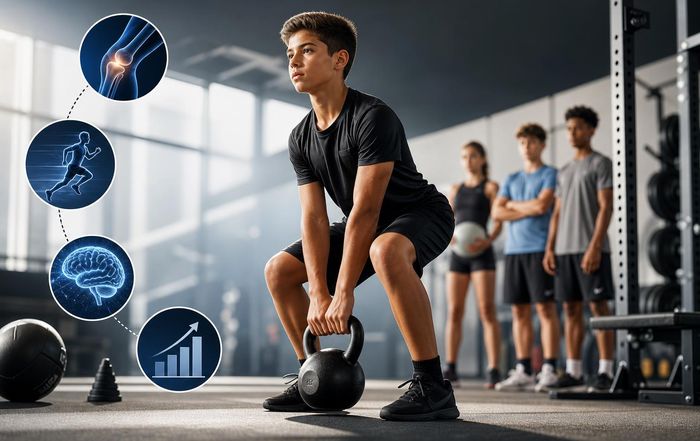
For youth athletes, the goal of strength training is not to build bodybuilder physiques or chase max lifts; it is to build a resilient, well-coordinated body that can handle the demands of training and competition. Age-appropriate programs support several key outcomes.
First, they enhance fundamental movement skills-squatting, hinging, lunging, pushing, pulling, rotating, and stabilizing. These patterns underpin nearly every sport, from football and basketball to swimming and tennis. A young athlete who can hinge at the hips properly, land softly from a jump, and brace the trunk effectively is better positioned to sprint, change direction, and absorb contact safely. This kind of movement literacy is as important as technical skills with the ball or racket.
Second, strength training supports speed and power development. Sprinting, jumping, and quick changes of direction all depend on how much force an athlete can produce and how quickly they can apply it. Well-structured resistance training improves rate of force development and helps athletes convert strength into explosive performance. This is particularly relevant during and after peak height velocity (the period of fastest growth), when limbs lengthen and coordination can temporarily suffer. Strength and neuromuscular work help "re-organize" the body around its new dimensions.
Third, age-appropriate resistance training supports long-term health markers. Studies have linked strength in youth with healthier body composition, better insulin sensitivity, stronger bones, and improved cardiovascular risk profiles. For young athletes who may already be training frequently, targeted strength work can balance repetitive sport-specific loads and reduce the risk of overuse injuries. For those in weight-sensitive or aesthetic sports, it can also help maintain lean mass and metabolic health in the face of high training volumes and, in some cases, pressure to restrict energy intake.
Readers interested in broader health impacts of training and recovery can find complementary coverage in sections such as health, fitness, and nutrition, where topics like sleep, fueling, and growth are frequently explored.
Injury prevention: building more robust youth athletes
Injury prevention is one of the strongest arguments for age-appropriate strength training. Youth sport has seen a rise in overuse injuries and serious ligament tears, especially in sports that encourage early specialization and year-round competition. Evidence from randomized trials and large cohort studies suggests that neuromuscular and strength programs can significantly reduce injury risk.
Structured warm-up and strength programs such as FIFA's injury-prevention protocols, which combine strength, balance, plyometrics, and movement control, have been associated with fewer knee and ankle injuries in youth football. Similar concepts are used across sports, focusing on landing mechanics, single-leg stability, trunk control, and eccentric strength (particularly of the hamstrings and quadriceps) to protect joints like the knee and ankle.
Key mechanisms include improving the ability to control knee valgus (inward collapse) during cuts and landings, enhancing hamstring strength to balance the quadriceps, and teaching athletes to land with flexed hips and knees rather than stiff, extended legs. Resistance training targeting the posterior chain (glutes, hamstrings, lower back), hip stabilizers, and trunk musculature plays a central role.
Organizations such as FIFA, World Rugby, and USA Football have all incorporated neuromuscular strength components into youth injury-prevention recommendations. For a broader look at how sport and health intersect globally, readers can also explore sports and world coverage.
Importantly, injury prevention benefits depend on consistency. A few weeks of exercises pre-season is not enough; these programs need to be integrated into regular training, often as part of the warm-up, and sustained throughout the competitive calendar.
How strength training should differ by age and maturation
"Age-appropriate" does not simply mean lighter weights for younger athletes. It means matching exercise selection, coaching style, and progression to the athlete's biological maturation, training age (experience), and psychological readiness.
For children roughly 7-11 years old, the emphasis is on learning movement patterns and enjoying activity. Sessions might include bodyweight squats, crawling, animal walks, medicine ball throws with light balls, simple pulling exercises like ring rows, and playful relay-style circuits. The focus is on coordination, balance, and technique rather than sets, reps, or load. External resistance can be introduced gradually with light dumbbells, resistance bands, or medicine balls, but the priority remains control and confidence.
For early adolescents around 11-14, growth spurts introduce rapid changes in limb length and body proportions. Many athletes temporarily appear clumsy or awkward. Training should account for this by emphasizing controlled tempo, symmetrical movement, and trunk stability. Loads can increase modestly, but jumps in weight should be conservative, and exercises that challenge single-leg control, deceleration, and landing should be incorporated. Coaches need to be especially alert to signs of overuse injuries in areas like the knees and heels, which are common around peak growth.
For mid to late adolescents (typically 14-18, though biological age varies), more traditional strength and power training becomes appropriate for many athletes. Barbell lifts such as squats, deadlifts, and presses can be introduced once foundational technique is established with lighter implements. Power exercises like loaded jumps or, in some cases, Olympic lift derivatives may be used under qualified supervision. Here, progression can be more structured, but the goal is still long-term development, not chasing short-term personal records at the expense of form or health.
Throughout all stages, the program should be integrated with total training and competition load. Youth athletes often juggle school teams, clubs, and sometimes regional or national squads. Coordinating strength work across these demands is essential to avoid excessive cumulative stress. Articles in wellness and events often touch on how busy competition schedules affect young athletes' recovery and wellbeing.
Designing practical, safe programs for young athletes
A practical youth strength program rests on several pillars: qualified supervision, appropriate exercise selection, conservative progression, and attention to the broader context of growth, sleep, and nutrition.
Supervision should come from coaches or trainers with specific knowledge of youth training, not just adult bodybuilding or powerlifting routines. Organizations such as the NSCA, UKSCA, and ACSM offer youth-specific education and certifications. Coaches must be able to teach and correct technique, recognize fatigue and early signs of injury, and adjust sessions on the fly.
Exercise selection should prioritize multi-joint, functional movements over isolated muscle work. Squats, hip hinges, lunges, pushes, pulls, rotations, and carries form the backbone of most sessions. Machine-based isolation exercises are not inherently harmful but are rarely the most efficient use of limited training time for young athletes whose primary goal is performance and injury resilience rather than aesthetics.
Progression should follow the principle of "mastery before load." Athletes first demonstrate consistent technique with bodyweight or very light resistance before progressing. Increases in load, volume, or complexity should be gradual and based on observed readiness. Maximal lifts (true one-rep max attempts) are generally unnecessary for most youth athletes; submaximal testing and performance metrics on the field or court provide plenty of feedback on progress.
Sessions should also be framed with a clear warm-up and cool-down. Dynamic warm-ups that include mobility, activation, and low-level plyometrics prepare the body and reinforce movement patterns. Cool-downs with light movement and stretching can aid recovery and reinforce good habits.
Nutrition and recovery are critical context. Youth athletes need sufficient energy and protein to support both growth and training adaptations. Guidance from reputable sources such as WHO, UNICEF, or national health agencies can help families understand baseline nutrition needs, while sport-specific advice is often available from organizations like Sports Dietitians Australia or The British Dietetic Association at bda.uk.com. Sleep, often overlooked, is another major driver of adaptation and resilience.
For those interested in the intersection of sport, technology, and training tools-such as wearables that track load or sleep-coverage in technology and innovation frequently explores how data is changing youth development pathways.
Recognizing and managing risks
While the overall risk profile of supervised youth strength training is favorable, it is not zero. Overuse injuries, acute strains, and joint irritation can occur, particularly when training is layered on top of heavy sport participation. Managing these risks means monitoring total load, not just what happens in the weight room.
Coaches and parents should watch for persistent pain that lasts beyond typical post-exercise soreness, especially around joints or growth plates (knees, heels, wrists). Sudden changes in training volume, such as adding multiple gym sessions during a busy competition period, are common triggers. Communication among coaches, parents, and health professionals is essential, particularly for athletes in talent pathways or academy systems where pressures to perform can be high.
Mental and emotional wellbeing also matter. Some young athletes may feel anxious about lifting, especially if they perceive it as a test of toughness or strength compared with peers. Others may become overly focused on physique or numbers at the expense of enjoyment and balance. Coaches should frame strength training as a tool for health, performance, and confidence rather than a measure of worth.
In cases of existing medical conditions, prior injuries, or uncertainty, consultation with a pediatrician, sports physician, or physical therapist familiar with youth sport is recommended. Organizations like Mayo Clinic at mayoclinic.org and NHS at nhs.uk provide accessible overviews of common youth musculoskeletal issues and general guidance that can complement sport-specific advice.
How clubs and schools can build better youth strength cultures
The biggest gains may come not from individual programs but from changing how clubs and schools think about strength work for young people. Instead of treating the gym as an optional add-on for older teens, strength and movement skill development can be woven into the fabric of youth sport from the earliest ages.
At grassroots level, this might mean multi-sport programs that emphasize varied movement skills, playful strength challenges, and basic bodyweight control. In school settings, physical education curricula can include structured resistance training units that teach safe lifting techniques and help students understand how strength supports everyday life, not just competitive sport. Articles in culture and environment increasingly explore how built spaces-gyms, playgrounds, and community facilities-shape youth activity patterns.
At talent and academy levels, coordinated long-term athlete development models can map out how strength, power, and movement training evolve from childhood through late adolescence. This reduces the risk of sudden, poorly planned exposure to heavy lifting at 15 or 16 and replaces it with a gradual, evidence-based pathway. Governing bodies, such as national sport federations and Olympic committees, are publishing more detailed frameworks, often drawing on research from institutions like NIH at nih.gov and IOC at olympics.com.
Finally, there is a role for broader policy and education. As interest grows in sports science careers, coverage in business and jobs often highlights the demand for qualified strength and conditioning coaches, physiotherapists, and sport scientists who understand youth development. Ensuring that people in these roles have appropriate training and support is central to making age-appropriate strength work the norm rather than the exception.
Bringing it together: strength as part of a bigger picture
Age-appropriate strength training is not a magic bullet, but it is a powerful tool when integrated into a holistic approach to youth sport. The evidence from organizations such as AAP at aap.org, NSCA at nsca.com, ACSM at acsm.org, and WHO at who.int points in the same direction: supervised, well-designed resistance training is safe for children and adolescents and offers clear benefits for performance, health, and injury resilience.
For young athletes, the central message is simple: learning to move well and build strength early lays the foundation for whatever path they choose in sport and life. For parents and coaches, the responsibility is to ensure that this training is tailored to developmental stage, grounded in good science, and delivered in environments that value technique, enjoyment, and long-term growth over short-term results.
As youth sport continues to evolve, strength training will likely become even more embedded in development systems worldwide. The challenge now is to make sure that every young athlete, not just those in elite programs, has access to safe, age-appropriate guidance that helps them grow stronger, stay healthier, and enjoy their sport for longer.