

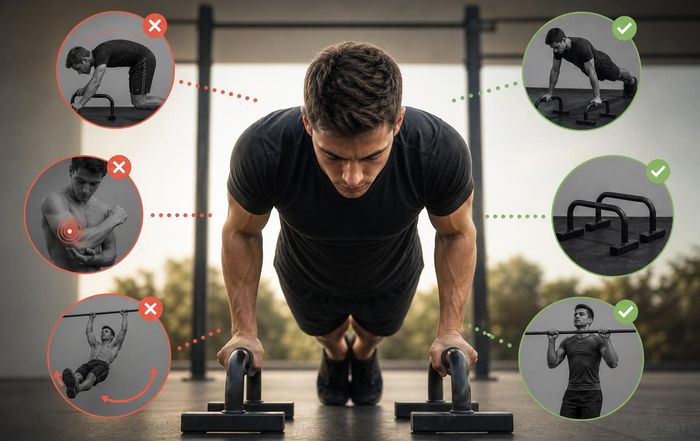
How to Avoid Common Mistakes When Starting Calisthenics
Starting calisthenics can be a powerful way to build strength, mobility, and control using nothing more than your bodyweight. Yet many beginners stall, get injured, or quit-not because the training style is flawed, but because they repeat the same avoidable mistakes. Understanding those pitfalls, and how to sidestep them, can save months of frustration and keep your progress steady and safe.
This fit guide focuses on practical, evidence-informed strategies for beginners who want to train smart. It draws on strength and conditioning principles, sports medicine guidance, and the specific demands of bodyweight training.
Mistake 1: Skipping the Basics and Chasing "Show-Off" Skills
One of the most common early missteps is trying to learn muscle-ups, handstands, or planches before having a solid foundation of basic strength and control. Social media is filled with advanced skills, and it is easy to assume that calisthenics "starts" there. In reality, those moves are the tip of a pyramid built on push-ups, rows, squats, lunges, planks, and simple hangs. Without this base, the body is forced to compensate with poor technique, momentum, and excessive joint stress, especially in the shoulders, elbows, and lower back. This is not just inefficient for progress; it materially increases the risk of overuse injuries and sudden strains.
A more sustainable approach is to treat basic patterns as your primary training focus for months, not weeks. Full-range push-ups with a rigid torso, controlled inverted rows, deep bodyweight squats, and hollow-body positions build the joint integrity and motor control required for harder variations. Regressions-such as incline push-ups, band-assisted pull-ups, or elevated rows-are not a sign of weakness; they are tools to ensure you are building strength in the right ranges. Organizations like the American College of Sports Medicine emphasize progressive overload and proper technique as cornerstones of safe strength training, principles that apply directly to calisthenics and are worth respecting from day one.
Mistake 2: Ignoring Joint Preparation and Mobility
Calisthenics demands large ranges of motion, especially in the shoulders, wrists, and hips. Newcomers often jump straight into push-ups, dips, and bar work with stiff joints and limited mobility, assuming that "it will loosen up over time." In practice, the opposite often happens: the body adapts around restrictions, leading to compensation patterns such as flared elbows in push-ups, hyperextended lower backs in planks and handstands, or shrugged shoulders during pull-ups. Over time, this can contribute to tendinopathy, impingement, or chronic discomfort that derails training.
Joint preparation does not require an elaborate routine, but it should be deliberate. Before upper-body sessions, controlled shoulder circles, scapular push-ups, band pull-aparts, and gentle wrist mobilizations help prepare tissues for load. Lower-body sessions benefit from dynamic hip openers, ankle dorsiflexion drills, and active hamstring movements. Resources from organizations such as the American Council on Exercise at https://www.acefitness.org/ and NHS Inform at https://www.nhs.uk/ outline safe warm-up and mobility approaches that can be adapted to bodyweight training.
For readers interested in broader flexibility and joint health as part of an overall wellness routine, exploring mobility-focused practices through our wellness and fitness sections can help connect calisthenics with long-term movement quality rather than short-term performance.
Mistake 3: Training Without a Plan or Progression
Many beginners start calisthenics with enthusiasm but no structure. One day they do push-ups and sit-ups, the next they try pull-ups and dips, and then they skip a few days because everything hurts. Without a framework for progression-how exercises become gradually more challenging over time-results are inconsistent and plateaus arrive quickly. Random sessions may feel "hard," but difficulty alone does not guarantee progress; the body adapts best to consistent, measurable stress.
A simple but effective structure is to choose a small set of key movements and progress them week to week. For example, a beginner might focus on push-ups, rows, squats, glute bridges, and planks three times per week, tracking total repetitions or time under tension. Once they can perform a given variation with solid form-say, 3 sets of 10-12 reps-they can progress by changing leverage (e.g., moving from incline to floor push-ups), adding tempo (slower eccentrics), or increasing volume. Guidelines from bodies like the National Strength and Conditioning Association at https://www.nsca.com/ and ExRx at https://exrx.net/ can help beginners understand basic progression models used in strength training.
Readers who are also balancing running, cycling, or team sports may find it useful to integrate calisthenics into a broader training plan; coverage in our sports and health sections often highlights how to structure complementary strength and conditioning alongside other activities.
Mistake 4: Doing Too Much, Too Soon
Bodyweight training can appear deceptively safe because there are no external weights involved. Newcomers sometimes assume they can perform daily high-volume push-ups, pull-ups, and squats without consequence. However, tendons, ligaments, and joint structures adapt more slowly than muscles. Rapid jumps in training volume or intensity can exceed the capacity of these tissues, leading to common overuse problems such as elbow tendinopathy, shoulder irritation, or patellofemoral pain around the knee. Sports medicine organizations, including the American Orthopaedic Society for Sports Medicine at https://www.sportsmed.org/, frequently highlight sudden workload spikes as a key risk factor for such issues.
A more measured approach is to respect recovery from the outset. Two to four full-body sessions per week are usually enough for beginners, with at least one rest or light-movement day between harder sessions. Within each workout, stopping one or two repetitions short of failure on most sets helps manage fatigue while still stimulating adaptation. Sleep, nutrition, and stress management also matter: chronic sleep deprivation or high life stress can impair recovery and increase injury risk. Our nutrition and wellness coverage often explores how diet and lifestyle choices support recovery from training, including protein intake, energy balance, and strategies for better sleep.
Mistake 5: Neglecting Technique in Favor of Reps
Chasing higher numbers-100 push-ups in a row, 20 pull-ups, endless squats-is a common motivation in calisthenics. Yet when form deteriorates, those repetitions stop reinforcing the skill and start reinforcing dysfunctional patterns. Common examples include half-rep push-ups that never reach full depth, kipping or swinging pull-ups performed with uncontrolled momentum, and squats that collapse at the knees or barely bend at the hips. While these may inflate rep counts, they do little to improve real-world strength or joint health.
Prioritizing technique means defining what a "good" repetition looks like and holding yourself to that standard. Full range of motion, controlled tempo, stable joints, and consistent breathing are key markers. Slowing down the eccentric (lowering) phase of movements can help build control and expose weaknesses. Many reputable organizations-including Physiopedia at https://www.physio-pedia.com/ and Mayo Clinic at https://www.mayoclinic.org/-emphasize technique quality over quantity for both rehabilitation and general fitness. If possible, occasional feedback from a qualified coach, physical therapist, or experienced practitioner can catch errors that are hard to see on your own.
For readers interested in performance in other domains-such as running economy or lifting technique-our technology and innovation sections sometimes explore movement-analysis tools and wearables that can complement self-assessment in calisthenics and beyond.
Mistake 6: Ignoring Pulling Strength and Posterior Chain Work
Many home calisthenics routines skew heavily toward pushing exercises: push-ups, dips, and core work often dominate, while pulling and posterior chain exercises are neglected. This imbalance can contribute to rounded shoulders, neck tension, and shoulder discomfort, especially in people who already spend long hours sitting or working at a computer. Balanced development of the upper back, glutes, and hamstrings is essential not only for performance but also for posture and long-term joint health.
Even with minimal equipment, there are solutions. A stable horizontal bar, suspension trainer, or sturdy table can allow bodyweight rows at various angles. Doorway pull-up bars open the door to assisted pull-ups using bands or chair support. For the lower body, hip hinges, single-leg Romanian deadlifts (with bodyweight), glute bridges, and hip thrusts train the posterior chain without external weights. Guidance from sources like Harvard Health Publishing at https://www.health.harvard.edu/ and Cleveland Clinic at https://my.clevelandclinic.org/ often underscores the importance of posterior-chain strength for back health and injury prevention.
Readers who enjoy following broader training trends and brand offerings-such as minimal-equipment home gym setups or portable bars-may find additional context and product coverage in our brands and business sections, where equipment design and accessibility are increasingly relevant topics.
Mistake 7: Overlooking Core Function (Not Just "Ab Work")
In calisthenics, the core is not just about visible abs; it is the link that transfers force between the upper and lower body. Weak or poorly controlled core musculature often shows up as sagging hips in push-ups and planks, banana-shaped handstands, and excessive arching during pull-ups or hanging leg raises. Many beginners attempt endless crunches or sit-ups as a solution, but these exercises do not always translate well to the full-body tension required in advanced skills.
A more functional approach focuses on anti-extension, anti-rotation, and full-body bracing. Exercises like hollow-body holds, dead bugs, side planks, and controlled leg raises (with posterior pelvic tilt) train the core to stabilize the spine under load. As skill increases, these patterns carry over to movements like handstands, levers, and advanced push-up variations. Sports performance resources from organizations such as USA Gymnastics at https://usagym.org/ and Canadian Sport Institute at https://csipacific.ca/ frequently emphasize this kind of integrated core training in gymnastic and acrobatic disciplines, which share many demands with calisthenics.
For those interested in how core training intersects with back pain, posture, or everyday function, additional background in our health and environment coverage occasionally touches on workplace ergonomics, sedentary behavior, and how movement practices can mitigate their effects.
Mistake 8: Not Aligning Training with Nutrition and Body Composition
Calisthenics performance is closely tied to relative strength-how strong you are relative to your bodyweight. Pull-ups, dips, levers, and handstands all become more accessible when unnecessary body mass is reduced and lean muscle is maintained or increased. Yet many beginners either ignore nutrition entirely or adopt extreme diets that undermine recovery and performance. Crash dieting can sap energy, reduce muscle mass, and increase injury risk, while chronic overeating may make bodyweight skills feel disproportionately difficult.
A balanced approach typically involves adequate protein intake, sufficient overall calories to support training, and an emphasis on nutrient-dense foods. Organizations such as the World Health Organization at https://www.who.int/ and Academy of Nutrition and Dietetics at https://www.eatright.org/ provide broad guidance on healthy dietary patterns. For those specifically interested in sports nutrition, the International Society of Sports Nutrition at https://www.sportsnutritionsociety.org/ publishes position stands on protein intake, energy availability, and supplementation that can help frame decisions around fueling training.
Our dedicated nutrition and health sections often examine how dietary strategies interact with training goals, including fat loss, muscle gain, and performance for bodyweight athletes, recreational exercisers, and people using calisthenics as part of a broader wellness plan.
Mistake 9: Comparing Yourself Constantly to Social Media Standards
Calisthenics has grown rapidly through social platforms, where highly skilled athletes showcase advanced skills, extreme physiques, and rapid transformations. While this can be inspiring, it can also distort expectations for beginners. People may feel they are "behind" because they cannot perform a muscle-up after a few weeks, or they may push into risky progressions to keep up with others. This comparison pressure can erode motivation, encourage unsafe training decisions, and overshadow the genuine satisfaction of gradual, personal progress.
Reframing success around individual benchmarks can help: your first strict push-up, your first controlled negative pull-up, or your first 30-second hollow hold are meaningful milestones, even if they never appear on a highlight reel. Sports psychology research, including work summarized by organizations like the American Psychological Association at https://www.apa.org/, highlights the benefits of process-focused goals-such as training consistently three times per week-over purely outcome-focused goals like achieving a specific skill by a set date. Treating calisthenics as a long-term practice rather than a short-term challenge can make the experience more sustainable and enjoyable.
For a broader look at how fitness culture, social media, and body image interact, our culture and world coverage often explores the social context around training trends, including calisthenics communities in parks and urban spaces worldwide.
Mistake 10: Failing to Listen to Pain and Early Warning Signs
Finally, many beginners either ignore pain or misinterpret it. The mantra "no pain, no gain" is still widespread, but sports medicine and public health organizations-including the Centers for Disease Control and Prevention at https://www.cdc.gov/-distinguish clearly between normal exercise-related discomfort and signs of potential injury. Sharp, localized pain, joint clicking with discomfort, persistent swelling, or pain that worsens with each session are red flags that warrant modification or professional assessment. Pushing through these signals in calisthenics, where joints are often loaded at long ranges of motion, can turn minor issues into chronic ones.
Developing body awareness is part of the practice. Mild muscular soreness that fades in 24-72 hours is generally normal, especially when starting or increasing training. In contrast, pain that alters your movement pattern-such as avoiding full range of motion because of discomfort-should prompt a step back. Reducing volume, regressing to easier variations, or taking a short deload period can often keep a small issue from escalating. When in doubt, consulting a qualified healthcare professional-such as a sports physician or physiotherapist-is preferable to self-diagnosing via forums or social media.
Readers interested in broader safety topics, including outdoor training environments, air quality, or heat exposure during park workouts, can find related context in our environment and world sections, where health and training intersect with climate, urban design, and public spaces.
Putting It Together: A Smarter Start to Calisthenics
Avoiding common mistakes in calisthenics is less about perfection and more about principles: build a foundation before chasing advanced skills, respect your joints and recovery, prioritize technique over volume, balance pushing with pulling and core stability, support training with sensible nutrition, and keep your progress personal rather than comparative. When these elements are in place, calisthenics becomes not just a way to exercise, but a sustainable movement practice that can evolve with you over years.
For those ready to begin or refine their approach, exploring related educational content across our fitness, health, nutrition, wellness, and sports sections can provide additional context-from injury prevention and lifestyle integration to the cultural and environmental factors shaping how and where people train. Starting calisthenics with these principles in mind will not guarantee an effortless journey, but it will help ensure that your effort goes toward meaningful, sustainable progress rather than avoidable setbacks.